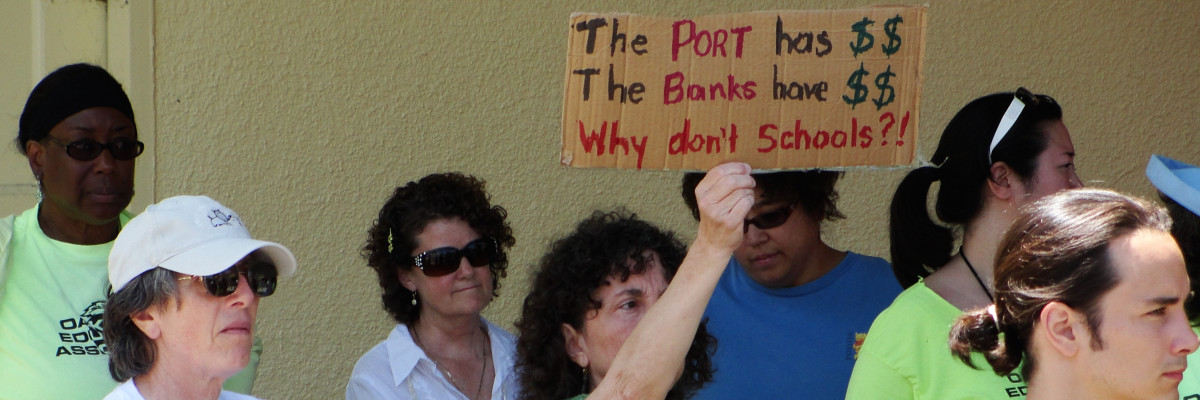
I taught high school social studies in Oakland, California, from 1990 until 2014, and currently work as a substitute. I usually began each year by asking students, “What kind of world do you want to live in and what can you do to help create it?” Since I want my students to see themselves as people who can participate in making a better world, how can I could I do less within the world of public education? How can we tell our students that every one of them can “thrive” (per our district’s current slogan) when we know that our existing teaching and learning conditions make that impossible?
In 2006 our union, the Oakland Education Association, approved a Vision for Education that “calls for creating the best conditions for teaching and learning for all students.” It calls for cutting class size to 15 or less, increasing preparation time, and many other improvements that are nearly never mentioned by billionaire school “reformers.” Because these changes are “expensive,” the OEA Vision calls for redistributing the ample wealth of Oakland’s largest corporations for public education and other vital services. While we’re often told such demands are “unrealistic,” as educators we know that to “expect success” (another district slogan) is truly unrealistic and hypocritical.
We believe that it’s well past time to demand what students really need to succeed and to fight for it. We will win as much as can be won with the forces we can organize. What do we have to lose by trying?
After the federal government bailed out the corporate criminals who caused the Great Recession of 2008, many asked, “Why are there trillions for banks, but nothing for public services, nothing for universal health care, nothing for our public schools?” Occupy Wall Street was one result. That moment passed, but the consciousness that this society is dominated by the interests of the One Percent remains. So is the sense of power the 99 percent can wield when inspired and mobilized. The fight for real equality in every aspect of the society, including education, will require large numbers of people to hit the streets and the picket lines to fight for these resources.